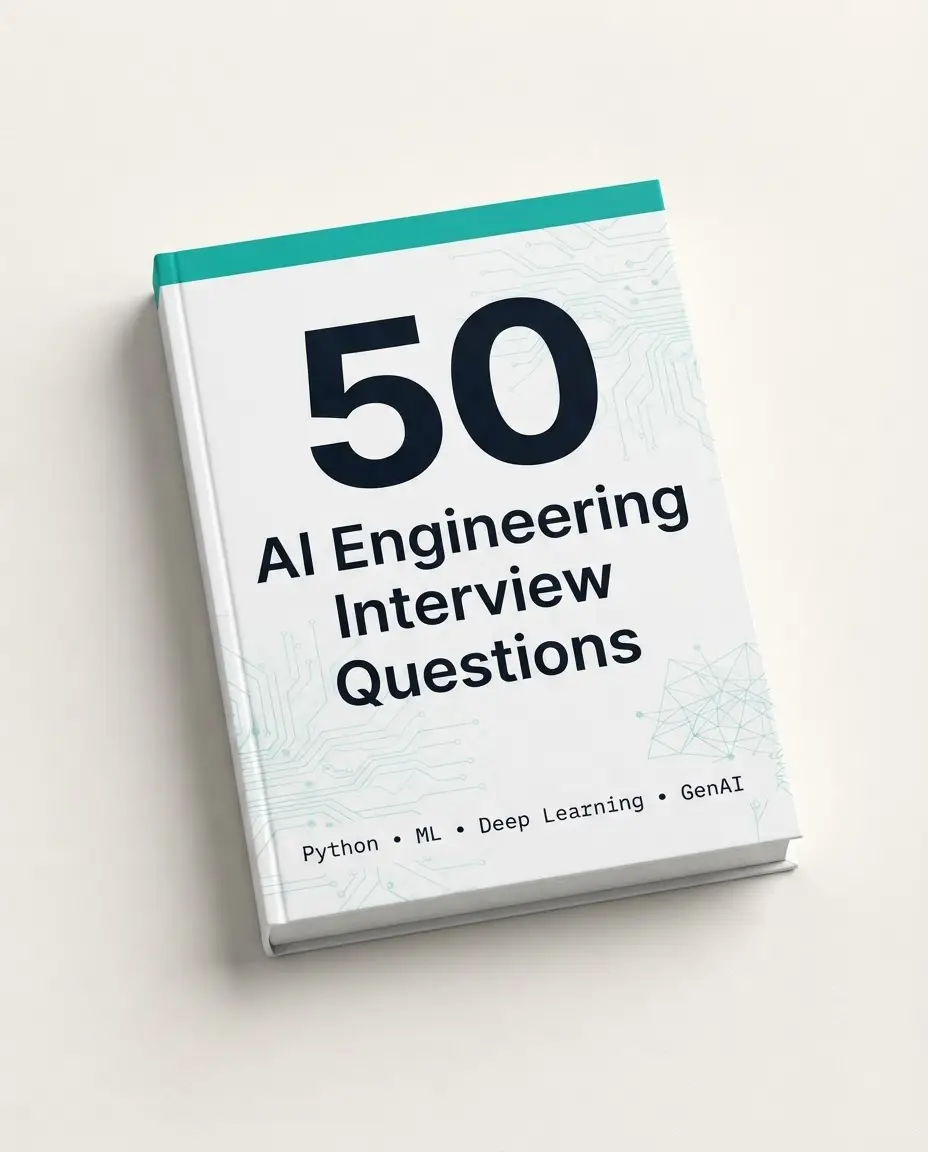
A free, no-fluff PDF covering Python, Machine Learning, Deep Learning, and GenAI — the exact questions hiring teams are asking at OpenAI, Anthropic, and AI-native startups right now.

PDF · 42 PAGES
Instant download
4,200+
Engineers downloaded
4.9/5
Average rating
50
Curated questions
$0
No paywall, no upsell
Engineers at these companies have used this to prep
// 01 — WHAT'S INSIDE
Built to mirror how AI engineering interviews actually run — from Python fundamentals to LLM production systems.
Decorators, generators, async, memory management, NumPy/Pandas idioms, and the Python patterns that show up in ML codebases.
Topics: OOP · async/await · GIL · data structures
Supervised vs. unsupervised, evaluation metrics, feature engineering, regularization, and the bias-variance tradeoff in practice.
Topics: bias/variance · cross-val · metrics · imbalanced data
Backpropagation, activation functions, CNN/RNN/Transformer intuition, vanishing gradients, and the architecture decisions that matter.
Topics: backprop · activations · CNNs · transformers
Transformer mechanics, RAG architecture, prompt engineering, fine-tuning trade-offs, and the production concerns hiring teams probe hardest.
Topics: attention · RAG · RLHF · hallucinations
// 02 — A TASTE
Real questions, the kind that come up in phone screens and onsites. Get a feel for depth — the full PDF covers forty-two more.
What is the GIL, and how does it affect multi-threaded code? When would you reach for multiprocessing instead?
Your classifier scores 99% accuracy on test data, but the PM says it's failing in production. Walk through how you'd diagnose this.
Explain the vanishing gradient problem. Which architectural choices fix it, and which activation functions make it worse?
Walk me through scaled dot-product attention, including the role of Q, K, and V, and why we scale by √dₖ.
Compare L1 and L2 regularization. When would you choose one over the other, and how do they affect feature selection?
When would you choose RAG over fine-tuning? How would you decide which approach fits a given use case and budget?
What are Python decorators? Walk me through a real use case where a decorator made your ML pipeline cleaner.
How do residual connections work, and why are they important for training very deep networks?
Plus 42 more covering chunking strategies, RLHF, vector databases, evaluation metrics, prompt injection, and more.
// 03 — WHY IT WORKS
Most AI interview lists recycle textbook questions. This one was built from actual interview debriefs at AI-native companies.
01
Every question came up in a real loop. No filler, no trivia.
02
Updated for the LLM era. Includes RAG, agents, evaluation, and the production concerns teams probe hardest.
03
Each question is marked entry, mid, or senior — so you prep for your level, not someone else's.
04
A framing note and key concepts for every question. Study smarter, not longer.
87%
Of users report it helped them land an interview
42pg
A focused read — under an hour to digest
4
Sections covering the modern AI stack
// 04 — FROM ENGINEERS
"Two of the system design questions came up almost verbatim in my Anthropic loop. The RAG one especially. Worth the email alone."
Priya K.
ML Engineer, hired at Anthropic
"I was prepping for a senior GenAI role and the depth on RAG and evaluation was the real signal. Most lists stop at 'what is an LLM' — this one actually goes where interviewers go."
Marcus R.
Senior AI Engineer, hired at a Series B AI startup
"Sent it to my whole team before our last hiring sprint. We ended up using a few of the GenAI questions directly in the loop — they surface real signal fast."
Jamie T.
Eng Manager, AI Platform team
// 05 — GET IT FREE
Drop your email and we'll send the PDF straight over. No upsell, no sequence of 17 emails — just the resource.
// 06 — COMMON QUESTIONS
Yes, free. We occasionally send updates when we publish a new resource — maybe twice a year. You can unsubscribe at any time, and we don't sell or share your email.
42 pages, standard PDF — readable on any device. Most engineers finish it in under an hour, but you'll likely want to come back to specific questions before each interview.
Every question comes with framing notes, key concepts to cover, and a sample strong answer. The goal is to help you think through the answer — not to memorize a script.
All levels. Each question is tagged (entry, mid, senior) so you can focus on what's most relevant. If you're early-career, lean into the Python and ML sections; if senior, the GenAI and system design depth is where the leverage is.
No. You'll get the PDF right after signing up and at most a couple of follow-ups about future resources. One-click unsubscribe is in every email.
Yes — reply to any email we send. The PDF is updated quarterly, and the best additions come from engineers who are actively in the loop.